
LATEST CAMPAIGNS
Whale Wash Film: Exposing Whaling
“Whale Wash” is an investigative documentary that digs deep into the modern Norwegian whaling industry. It aims to answer the question of why Norway still hunts whales in the 21st century while many other historical whaling nations have ceased this archaic practice. Our research aims to understand why Norway continues to maintain a whaling industry; the science used to determine quotas, the ethical claims used to justify modern harpooning, whale meat contaminants, and the impact it has on whale stocks and the oceans.
ESPA investigators Pete and Hannah have captured contemporary footage of whale hunts in action and interviewed scientists, whalers, and Norwegian locals to gain insights into why Norway hunts over 500 minke whales each year.

The issue
Norway has taken the approach that minke whales are a Norwegian resource to manage as Norway sees fit, but as a migratory species, minke whales cover vast amounts of ocean during their breeding cycles and pass through the territorial waters of several countries – including off the Yorkshire coast of the UK – as they take their yearly journeys between their feeding grounds in the north and breeding grounds in the south. ESPA believes that all minke range states should have a voice in the protection of this little-understood cetacean.
What we wanted to achieve
Norway is one of the last three countries that still engage in industrial whaling. However, the country’s decision to maintain its whaling industry has gone mostly unnoticed. Since Iceland’s whaling industry is in apparent terminal decline, ESPA conducted in-depth research on Norway’s whaling operations to determine why the country continued to maintain a whaling industry when other historic whaling nations, such as the UK and USA, ceased whaling several decades ago due to its negative impact on whale stocks. The objective of the research was to build credible evidence, correct inaccuracies, question the supposed science and present the findings to the Norwegian people and other range state politicians. The goal was to reveal the true reality of modern-day whaling in Norwegian waters.

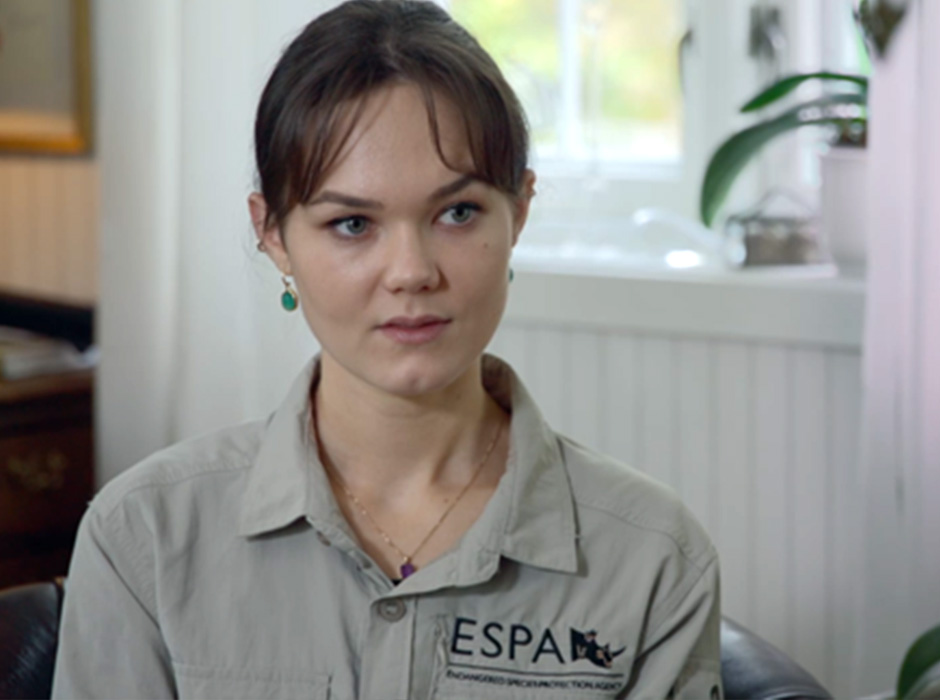

ESPA Investigators Hannah and Pete lead two separate missions to determine the reality of modern-day whaling in Norwegian Waters
Our investigation team
Pete has long admired the minke whales that pass by his home in Yorkshire, UK, every year. When he learns that the same whales are being hunted in nearby Norwegian waters, he cannot help but question why. Pete tasks ESPA Senior Investigator Hannah to dive deeper into why this is happening in modern-day Norway. Meanwhile, Pete leads a specialist military-trained operations crew to the northern tip of Norway for the whaling season. Their mission is to capture the reality of Norwegian whale hunting to trigger further investigation into the barbaric industry.
Hannah’s diligent research uncovers whale meat’s dwindling domestic demand and low exports, resulting in the industrial use of whale meat in pet food. Her findings become increasingly concerning as severe human health risks—especially for women and children—associated with whale meat consumption are brought to light. She proves beyond doubt that Norway’s minke whale quota is determined by weak and incomplete science and that the under-researched minke whales perform critical ecosystem services, boosting marine life and drawing carbon from the atmosphere, which is sequestered in the ocean depths.
Pete’s crew encounter Norway’s biggest whaling operator and records inhumane whale hunts – dispelling the ethical argument used by the industry – they are confronted with the scale of industrial whaling in the 21st century. Which whale species could be next if whaling in Norway continues? Norwegian whalers are already looking to exploit the humpback and fin whales. This documentary will drive change and hasten the cessation of commercial whaling in Norwegian waters.
We needed to gain insights from Norwegian experts, the public, and the industry, scrutinize their arguments, and disseminate our findings to a broader audience.
More information and how to watch the film
For more information about the investigation,
visit our website whalewashfilm.com


